How our process works
Freeze-drying removes water from frozen botanicals at low temperatures, helping preserve their natural structure and heat-sensitive compounds. Vortex Freeze-Dry combines drying and milling in one continuous process, reducing added heat, transfers, and handling. Below, we break down what’s in each formula and where the numbers come from.
Tested. Audited. Disclosed.
Independent testing, audited manufacturing, and clearly stated amounts in every serving.
Independently assayed
One Black Ginger production lot measured 8.3 mg of 5,7-DMF per serving in third-party HPLC-UV testing by MS Bioanalytical in Illinois.
1,000 mg per serving
Every Marcapa formula provides 1,000 mg per two-capsule serving, with ingredient amounts clearly disclosed on the Supplement Facts panel.
SGS-audited facility
Our Lamphun facility is audited by SGS to Thai Ministry of Public Health Standard No. 420 at Excellence Level. Certificate TH22/00000590, valid through August 2028.
What’s in each formula
Species, plant part, and amount—formula by formula.

700 mg per serving
Kaempferia parviflora
Black Ginger
Native to Southeast Asia
Kaempferia parviflora is a rhizome in the ginger family, known for naturally occurring compounds called polymethoxyflavones. Marcapa Black Ginger provides 700 mg of freeze-dried rhizome per serving. In one production lot, third-party HPLC-UV testing measured 11.8 mg of 5,7-dimethoxyflavone per gram, equal to 8.3 mg per two-capsule serving.
What we tested
The 8.3 mg figure comes from one production lot (ACY-BG-1265322), tested by MS Bioanalytical using method STM-3.147. It represents one measured compound within the broader polymethoxyflavone group.
How the research differs
Published performance studies used concentrated Kaempferia parviflora extracts at 180–360 mg per day, typically over 12 weeks. Marcapa uses freeze-dried rhizome rather than a concentrated extract, so those milligram amounts are not directly comparable to ours.

300 mg per serving
Cordyceps militaris
Fruiting Body
A cultivated species
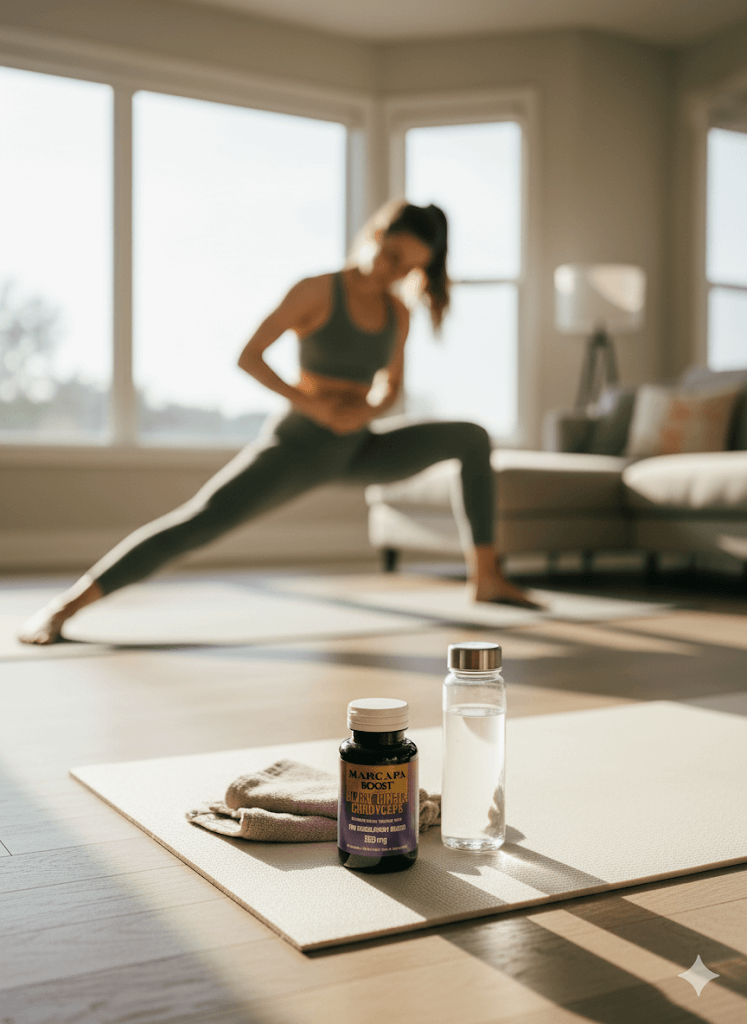
Cordyceps militaris, fruiting body. Three different organisms reach the market as "cordyceps": Ophiocordyceps sinensis, which is wild and essentially unavailable outside Asia; Cs-4, a fermented mycelium; and Cordyceps militaris, a separate species whose fruiting bodies are cultivated routinely. The chemistry follows the taxonomy — the cordycepin genes C. militaris carries are absent from O. sinensis. That is why the species is on our label.
Fruiting body
The part that grows above the grain it was cultivated on. The mycelium is the part that threads through the grain below it.
Cordycepin assay, next
A cordycepin or adenosine assay on this material is still to come. Until then the specification is the species, the part and the 300 mg.

of a single ingredient
Phyllanthus emblica
Amalaki (Amla)
Whole fruit, freeze-dried
Phyllanthus emblica, the whole fruit, dried and milled — 500 mg per capsule and 1,000 mg in a two-capsule serving. The fruit’s characteristic compounds are hydrolysable tannins — gallic acid, ellagic acid and corilagin. They degrade with heat, which is why the drying method counts for more with this one than with most things in the range.
Whole fruit, milled
500 mg per capsule of dried Phyllanthus emblica, milled from the whole berry.
No lab number on this one yet
Black Ginger has a third-party assay behind it. The amla is next in line for one, most likely measuring gallic acid.

botanicals, all declared
Six botanicals
Marcapa Cognitive
1,000 mg per serving
Lion’s mane fruiting body, black rice, matcha, jiaogulan, black ginger and moringa leaf. A two-capsule serving is 1,000 mg, and the label prints what share each of the six takes. The matcha brings roughly 5 to 7 mg of caffeine a serving, a fraction of what is in a cup of tea.
250 mg of lion's mane fruiting body
The mushroom itself. Most cheap mushroom powder is mycelium milled together with the grain it grew on, and published analyses put that at 33 to 68 percent starch, against about one percent in fruiting body.
All six amounts, printed
Lion's mane 250 mg, black rice 230 mg, matcha 200 mg, jiaogulan 150 mg, black ginger 100 mg, moringa leaf 70 mg. The law asks only for the blend total.
5 to 7 mg of caffeine
All of it from the matcha. Under 10 mg in a serving.